Signed up with twitter.
Trying to explore the options on twitter.
Please follow in twitter :
http://twitter.com/SriniCenthala
Saturday, February 28, 2009


Tuesday, February 24, 2009
What is the future of SaaS (Software as a Service)? Do you think it will succeed? If yes, why?
What is the future of SaaS (Software as a Service)? Do you think it will succeed? If yes, why?
Future SaaS of DW / BI and also other software development & environment are extremely promising:
Yes. It will Succeed.
Because
1. Infrastructure costs are reduced instead of one time huge investment
2. Reduced in Software cost by usage instead of buying
3. Implementation cost on IT Consultants reduced
4. Latest - Security reliability
5. Current Internet Speed & their Cost
6. Reduced - Operations cost on System Administration
7. Cost Spent Efficiently for the Usage.
8. There would not be any new upgrades , new technology transfers , because currently N number of Softwares are coming into Market & their Support
9. Any time pick different Service Provider & advancement with new trends & Technologies.
-- There are lot to go on.
Thanks,
Srini
Innovative IT Business Solutions Provider : www.absolut-e.com
Services Market Place: www.eServicePalce.com -- Where SaaS for Services Industry - Selling Process.
My Blog: http://SriniCenthala.blogspot.com
Links:
http://SriniCenthala.blogspot.com
http://www.eServicePalce.com
Future SaaS of DW / BI and also other software development & environment are extremely promising:
Yes. It will Succeed.
Because
1. Infrastructure costs are reduced instead of one time huge investment
2. Reduced in Software cost by usage instead of buying
3. Implementation cost on IT Consultants reduced
4. Latest - Security reliability
5. Current Internet Speed & their Cost
6. Reduced - Operations cost on System Administration
7. Cost Spent Efficiently for the Usage.
8. There would not be any new upgrades , new technology transfers , because currently N number of Softwares are coming into Market & their Support
9. Any time pick different Service Provider & advancement with new trends & Technologies.
-- There are lot to go on.
Thanks,
Srini
Innovative IT Business Solutions Provider : www.absolut-e.com
Services Market Place: www.eServicePalce.com -- Where SaaS for Services Industry - Selling Process.
My Blog: http://SriniCenthala.blogspot.
Links:
http://SriniCenthala.blogspot.
http://www.eServicePalce.com
Thursday, February 12, 2009
Wednesday, February 11, 2009
Needed Promotion Help for www.eServicePlace.com

We are trying to promote http://www.eServicePlace.com , any help would be appreciated. We would try your ideas of promoting. But we need further more not only on promoting , use frequently on posting your any kind of Service Requests (Public Requests) it is totally free.
This is very good concept & we need help each one of you to be successful concept to reality.
Planning to set up an Advisory board and try to add each one of the helping persons into this board. Please suggest if you have any ideas how to get lot of Public requests.
How Can you Help us ?
1. Post you Service Needs & request as a Public request
2. Provide us input to how could we improve ?
3. Suggestions & email note to be involved in the www.eServicePlace.com Advisory board.
4. If you think you can help us on getting investors.
What is eServicePlace?
Services market place that connects to the service requester and service providers all over the world but currently it is released only USA. In United States of America alone there are 33 Million service providers and nearly a Billion requesters (General Public). Every day there are service requesters who need service providers to enable the ease of their service. Absolut-e has realized this need and has developed eServicePlace.com to maintain the service requesters and providers transactions by enabling tools to efficiently manage the community. The following are the key features of eServicePlace.com:
1. Finding the providers and requesters
2. Placing service request
3. Bidding on the service request
4. Scheduling appointment for on-site estimation
5. Scheduling appointment for performing the services
6. Provider selection
7. Contract management
8. Work order management
9. Managing the service status
10. Financial management
11. Payment management
12. Rating/Review of requesters and providers
Feel free to use and provide your valuable input to make http://www.eserviceplace.com a successful concept to reality.
Thanks,
Srini
http://SriniCenthala.blogspot.com
Monday, February 9, 2009
Oracle's Hyperion Financial Management
Oracle's Hyperion Financial Management:
Oracle's Hyperion Financial Management is a comprehensive, Web-based financial system software application that delivers global collection reporting and analysis in a single, highly scalable financial management software solution. Financial Management to consolidate data from diverse general ledger systems (GL) and locations around the globe.
Financial Management 11.1.1 :
Oracle's Hyperion Financial Management is a comprehensive, Web-based financial system software application that delivers global collection reporting and analysis in a single, highly scalable financial management software solution. Financial Management to consolidate data from diverse general ledger systems (GL) and locations around the globe.
Financial Management 11.1.1 :
What problems new online BI would Solve?
What problem online BI which we are going to create would solve:
Problem Statement:
The main problem with Business Intelligence & Data Warehouse Projects:
1. BI and Data Warehouse projects are always problematic to complete it on time , insufficient technical designer , Wrong Requirement capture , In -sufficient of funds to complete the project.
2. Pre-Defined data warehouse & BI would not be enough to meet the Business user requirements. Since there are no common model for each of the performance measurement techniques.
Problem Statement:
The main problem with Business Intelligence & Data Warehouse Projects:
1. BI and Data Warehouse projects are always problematic to complete it on time , insufficient technical designer , Wrong Requirement capture , In -sufficient of funds to complete the project.
2. Pre-Defined data warehouse & BI would not be enough to meet the Business user requirements. Since there are no common model for each of the performance measurement techniques.
Thursday, February 5, 2009
What is cheat sheet ? Check out http://cheatsheet.absolut-e.com
Cheat Sheet are quick reference guide as reference cards.
In more general usage, a "cheat sheet" is any short (one or two page) reference to terms, commands, or symbols where the user is expected to understand the use of such terms etc but not necessarily to have memorized all of them. Many computer applications, for example, have cheat sheets included in their documentation which list keystrokes or menu commands needed to achieve specific tasks to save the user the effort of digging through an entire manual to find the keystroke needed to, for example, move between two windows.
Usage of Cheat Sheet -->
1. To capture Maths formulas
2. To capture syntax of particular Software or package or Computer Language.
and much more..
Please check out : http://cheatsheet.absolut-e.com , You can create your own cheat sheet or reference card. Still on development. We will be releasing soon with OpenId and on that time you can create your own CheatSheet and create PDF.
Feel free to provide your suggestion on this application http://cheatsheet.absolut-e.com
In more general usage, a "cheat sheet" is any short (one or two page) reference to terms, commands, or symbols where the user is expected to understand the use of such terms etc but not necessarily to have memorized all of them. Many computer applications, for example, have cheat sheets included in their documentation which list keystrokes or menu commands needed to achieve specific tasks to save the user the effort of digging through an entire manual to find the keystroke needed to, for example, move between two windows.
Usage of Cheat Sheet -->
1. To capture Maths formulas
2. To capture syntax of particular Software or package or Computer Language.
and much more..
Please check out : http://cheatsheet.absolut-e.com , You can create your own cheat sheet or reference card. Still on development. We will be releasing soon with OpenId and on that time you can create your own CheatSheet and create PDF.
Feel free to provide your suggestion on this application http://cheatsheet.absolut-e.com
Wednesday, February 4, 2009
BI On Demand SAP-BO
http://www.crystalreports.com/
What is crystalreports.com?
crystalreports.com is a web-based report-sharing service that enables companies, regardless of size or IT resources, to instantly share business-critical information with the right people in a simple and secure manner. Often, Crystal Reports users distribute reports in either PDF or Excel via email or hard copy - a manual process which is time consuming and difficult to manage. With crystalreports.com, customers can further leverage their investment in Crystal Reports by instantly sharing and storing their reports on the web with no additional hardware, software or IT resource requirement. We host the service on your behalf.
What is Business Intelligence OnDemand (BIOD) for crystalreports.com?
BIOD for crystalreports.com is an option for enterprises or companies with large datasets that are looking for more in-depth BI tools that provide advanced reporting, real-time dashboards, and powerful ad-hoc analysis tools for maximizing the value of your corporate data. The key difference between standard crystalreports.com and BIOD is that crystalreports.com is based on hosting live report and dashboard files within the Business Objects OnDemand platform, and BIOD is based on hosting a copy of the actual data sources within our OnDemand platform.
What Is Business Intelligence OnDemand?
Business Intelligence OnDemand is a BI solution that is ideal for organizations that:
- Have large data volumes (hundreds of thousands or millions of records).
- Use multiple data sources with a high level of complexity.
- Need deep analytics - such as ad-hoc and what-if analysis for planning.
Offload Your Infrastructure Costs
- We build and maintain your data warehouse and business intelligence infrastructure.
- You don't have to deal with IT department time and cost hurdles.
Access the World's Leading BI Platform
- Use the full spectrum of industry-standard BI tools from Business Objects.
- Get a high-volume reporting infrastructure - with more data volume and better performance than your core application.
Business Objects XI Release 2 Enterprise (BO) Features.
Main tools in BO XI R2:
Reporting,Query Analysis,Performance management & Data Integration.
Mainly integrated product together a) Crystal Reports & Business Objects.
Tools for Migration from Previous Versions:
Tool: BusinessObjects Designer or Universe Builder
Business Objects DeskTop Intelligence: To create new reports , ad-hoc queries ..
Business Objects web Intelligence : To create & publish new reports to web directly.
Publishing wizard : To create new documents to BO XI R2
InfoView : Create portal used for all of BI.
Central Management Console(CMC) : Web Interface to administrate such as create user roles, server admin.
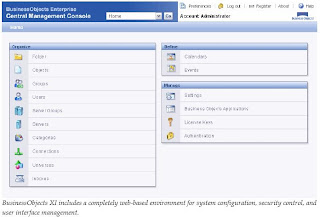

Service-Oriented Architecture and BI Platform Management :-
BusinessObjects Enterprise is designed as a services-oriented architecture for flexible system configuration. Each system service—such as report caching, scheduling, or analytic
engines can be set up and controlled from within the CMC. This gives
administrators the ability to add, remove, stop, restart, and reconfigure
system services directly from the web environment. They can also configure
services while the system is still running, eliminating the need for a system restart. The webbased environment enables administrators to access and manage the system from any web
browser with system access rights.

Reporting,Query Analysis,Performance management & Data Integration.
Mainly integrated product together a) Crystal Reports & Business Objects.
Tools for Migration from Previous Versions:
- Import Wizard:
- Desktop application to import user accounts,groups,reports and folders from crystal info into BO XI R2 Enterprise.
- BO version 5.1.4 ,6.0,6.1 and 6.5
- Crystal Enterprise 8.5,9 & 10
- Application foundation 6.1b,6.5.1
- Move Test Deployment of BO XI R2 to Production environment
- Repository migration wizard: Usage:- To Migrate from Report Design Repository to BO XI repository
- Data Source migration wizard: Usage :- To migrate reports based on crystal queries , dictionaries and info views.
- Report conversion Tool:
- Legacy BusinessObjects reports previously migrated to Desktop Intelligence using import wizard.
- Desktop Intelligence reports to web Intelligence reports to convert to web reports.
Tool: BusinessObjects Designer or Universe Builder
Business Objects DeskTop Intelligence: To create new reports , ad-hoc queries ..
Business Objects web Intelligence : To create & publish new reports to web directly.
Publishing wizard : To create new documents to BO XI R2
InfoView : Create portal used for all of BI.
Central Management Console(CMC) : Web Interface to administrate such as create user roles, server admin.


Service-Oriented Architecture and BI Platform Management :-
BusinessObjects Enterprise is designed as a services-oriented architecture for flexible system configuration. Each system service—such as report caching, scheduling, or analytic
engines can be set up and controlled from within the CMC. This gives
administrators the ability to add, remove, stop, restart, and reconfigure
system services directly from the web environment. They can also configure
services while the system is still running, eliminating the need for a system restart. The webbased environment enables administrators to access and manage the system from any web
browser with system access rights.

Tuesday, February 3, 2009
How to Submit your site to Google ?
Step1
Go To http://www.google.com/intl/en/submit_content.html , then Click on "Add Your URL"Or Directly to http://www.google.com/addurl/?continue=/addurl
Enter the URL / Domain Name / Web Site Address Starting with the "http" prefix. For example, Example: "http://www.eServicePlace.com"
Step2
Find the best keywords for your website to list in the comment section. The best way to do this is with a keyword selector tool like Keyword Discovery. Enter one to three words that best describe your web page, and look for the number of hits returned. At least 100 hits is a respectable number. List the best keywords for Google. Step3
Type in the squiggly letters that you see. Even though Google states that this is optional, doing so lets them know that you're not a software robot. Step4
Understand that submitting your URL is no guarantee that your website will be added to the Google index. Increase your chances by making your site more Google-friendly. You must sign up for a Google account to use the Google webmaster tools. Step5
Check that all links and html information works and looks like you want it to. A good way to test this is by checking your web pages with different browsers, including Internet Explorer, Netscape, Firefox and Mozilla. Step6
Include a sitemap with your website. This is not only helpful to users, but Google uses URL sitemaps to increase searchability.Monday, February 2, 2009
Looking for any data Warehouse project/s
Hi All,
Looking for any data warehouse project/s to work on. I am a Sr.Data warehouse Architect .
Here are the summary:
Please contact me for any referrals.
Looking for any data warehouse project/s to work on. I am a Sr.Data warehouse Architect .
Here are the summary:
SUMMARY:
· Over 16 years of Information Technology (IT) industry experience in the area of full life cycle software development of commercial client-server and web applications as Technical Architect / Data Architect / Data Modeler in business data management system. Over 11 Years US On-site Client Experience.
· Over 9 years of Experience in Decision Support System Using OLAP, ROLAP,MOLAP & HOLAP as BI Architect / Data Architect / Data Modeler.
· All the projects were completed and implemented successfully on time with in allocated budget with High Quality standards.
· Extensively used Rational Unified Process (RUP) Methodologies & Delivered Quality Standards SEI CMM model Level 4 & 5.
· Re-Engineered the Business Process of Revenue Management, Marketing Management, Contract Management, and Pricing Engine for United Parcel Service (UPS).
· Business process re-engineering to convert from HR People Soft to JD Edwards and Designing data warehouse to enable decision support system (DSS) of Human Resources (HR), Sales & Marketing, Manufacturing, Finance (GL) & Inventory management Applications.
· Expert in Designing of Data warehouse, Business Intelligence tool, ETL Process, Data Mining, Data Mapping, Data conversion, Data Migration using Data Stage, Informatica, Microstrategy 8i, Cognos & Business Objects.
· Extensive experience in Data Modeling, Database Design, System Architecture, System Design, Database Administration, Relational to object mapping, Object Oriented Analysis and Design.
· Very good experience in Oracle DBA activities, SQL, PL/SQL, Pro*C , Oracle Stored Procedures, Functions, Triggers , SQL / Loader ,SQL / Plus ,Back UP & Recovery and SQL Tuning.
· Good Experience in Java, J2EE & JMS using application server, e-commerce, B2B and B2C portals and System Integration (B2Bi and EAI).
IT SKILL SUMMARY
| Hardware | Pentium , Sun-Solaris Servers, HP 9000 Servers and IBM machines |
| Operating Systems | Windows-2003/XP, Linux , UNIX (HP-UX/Solaris/SCO) |
| Languages | SQL, PL/SQL, Java, XML, UNIX Shell, HTML/DHTML, UML, XSLT |
| Databases | Oracle, TeraData, SYBASE, SQL Server, MySQL, Netezza |
| BI Tools | MicroStrategy 8i, Cognos, Oracle Express, Business Objects |
| ETL Tools | Informatica, Data Stage, Oracle Warehouse Builder |
| Other Tools | Rational Rose, MS Project , ERWin, PowerDesigner |
| IT General Skills | Project Management, Business Process Re-Engineering (BPR), System Analysis & Design, System Architect, Data Modeling, Database Administration and Operations Management |
| Applications | Government, Finance, Banking, Operations (Manufacturing), Revenue Management system, Retail Industry, Transportation& Construction, e-commerce, Health & Medical Industry |
| Workflow Engine | Biz Flow 8.7 , MQ Series Work Flow engine |
| EAI Tools | MQSeries & Web Methods |
Please contact me for any referrals.
Services Market Place www.eServicePlace.com
 Services market place that connects to the service requester and service providers all over the world but currently it is released only
 The following are the key features of eServicePlace.com:
1. Finding the providers and requesters
2. Placing service request
3. Bidding on the service request
4. Scheduling appointment for on-site estimation
5. Scheduling appointment for performing the services
6. Provider selection
7. Contract management
8. Work order management
9. Managing the service status
10. Financial management
11. Payment management
12. Rating/Review of requesters and providers
Look at "How It works" --> http://www.eserviceplace.com/services/howitworks/home.do
Please provide valuable input & we are in the process of promoting eServicePlace.com
Any help would be appreciated.
Polls: http://polls.linkedin.com/p/21365/frxdf
BI Tools evaluation
BI Tools evaluation: [ Thanks to Business Intelligence group]
Let me consolidate from all of the discussion from this answers & try to evaluate BI tools.
Available Tools in the Market
Big Guys:
1. Mirostrategy
2. Business Objects
3. Cognos
4. OBIEE
5. SAS
6. Hyperion
7. MS BI
8.
New & recent companies:
gooddata : http://www.gooddata.com/products/index.html
birst : http://www.birst.com/pricing.php
QlikView: http://www.qlikview.com/home.aspx
Space-Time Research (STR): http://www.str.com.au/products.html
PowerOLAP: www.paristech.com
evaluation cretira:
------------------
http://www.bipminstitute.com/template/business_intelligence_tool_evaluation.php
ETL Tools :
1. Data Stage
2. Informatica
3. Oracle Warehouse Builder
Please add in any I have missed out or you wanted to include in the provided list. So I would try to compare , provide my recommendations.
Let me consolidate from all of the discussion from this answers & try to evaluate BI tools.
Available Tools in the Market
Big Guys:
1. Mirostrategy
2. Business Objects
3. Cognos
4. OBIEE
5. SAS
6. Hyperion
7. MS BI
8.
New & recent companies:
gooddata : http://www.gooddata.com/products/index.html
birst : http://www.birst.com/pricing.php
QlikView: http://www.qlikview.com/home.aspx
Space-Time Research (STR): http://www.str.com.au/products.html
PowerOLAP: www.paristech.com
evaluation cretira:
------------------
http://www.bipminstitute.com/template/business_intelligence_tool_evaluation.php
ETL Tools :
1. Data Stage
2. Informatica
3. Oracle Warehouse Builder
Please add in any I have missed out or you wanted to include in the provided list. So I would try to compare , provide my recommendations.
Thursday, January 29, 2009
Data Modeling - Normalization process (1NF,2NF,3NF)
What is Normalization ?
Normalization is the process of putting things right.
First normal form (1NF):
------------------------
Table faithfully represents a relation and has no "repeating groups"
Second normal form (2NF):
-------------------------
No non-prime attribute in the table is functionally dependent
on a part (proper subset) of a candidate key
Third normal form (3NF):
------------------------
Every non-prime attribute is non-transitively dependent on every key of the table
----------------------------------------------------------------------------------------
First Normal Form (1NF)
First normal form (1NF) sets the very basic rules for an organized database:
* Eliminate duplicative columns from the same table.
* Create separate tables for each group of related data and
identify each row with a unique column or set of columns (the primary key).
Second Normal Form (2NF)
Second normal form (2NF) further addresses the concept of removing duplicative data:
* Meet all the requirements of the first normal form.
* Remove subsets of data that apply to multiple rows of a table and place them in separate tables.
* Create relationships between these new tables and their predecessors through the use of foreign keys.
Third Normal Form (3NF)
Third normal form (3NF) goes one large step further:
* Meet all the requirements of the second normal form.
* Remove columns that are not dependent upon the primary key.
-----------------------------------------------------------------------------------------------------
Example:
--------
Bookshelf: Title, Author,Publisher,Category
Create a Entity called BOOKSHELF, it consits of following columns: Title,Author1,Author2,Auther3,Publisher,Category1,Category2,Category3
BOOKSHELF: TITLE,PUBLISHER,CATEGORY1,CATEGORY2,CATEGORY3,RATING,RATING_DESC
BOOKSHEL_AUTHOR: TITLE,AUTHOR_NAME
AUTHOR: AUTHOR_NAME , Comments
Above step refers to 1NF. regrouping of repeated groups into respective table.
Create a RATING Table with RATING,RATING_DESC , this step is called 2NF.
Remove category1,Category2,Category3 to seperate table called Category Table.
Create CATEGORY table with CATEGORY_NAME,PARENT_CATEGORY,SUBCATEGORY , this step is called 3NF.
Normalization is the process of putting things right.
First normal form (1NF):
------------------------
Table faithfully represents a relation and has no "repeating groups"
Second normal form (2NF):
-------------------------
No non-prime attribute in the table is functionally dependent
on a part (proper subset) of a candidate key
Third normal form (3NF):
------------------------
Every non-prime attribute is non-transitively dependent on every key of the table
----------------------------------------------------------------------------------------
First Normal Form (1NF)
First normal form (1NF) sets the very basic rules for an organized database:
* Eliminate duplicative columns from the same table.
* Create separate tables for each group of related data and
identify each row with a unique column or set of columns (the primary key).
Second Normal Form (2NF)
Second normal form (2NF) further addresses the concept of removing duplicative data:
* Meet all the requirements of the first normal form.
* Remove subsets of data that apply to multiple rows of a table and place them in separate tables.
* Create relationships between these new tables and their predecessors through the use of foreign keys.
Third Normal Form (3NF)
Third normal form (3NF) goes one large step further:
* Meet all the requirements of the second normal form.
* Remove columns that are not dependent upon the primary key.
-----------------------------------------------------------------------------------------------------
Example:
--------
Bookshelf: Title, Author,Publisher,Category
Create a Entity called BOOKSHELF, it consits of following columns: Title,Author1,Author2,Auther3,Publisher,Category1,Category2,Category3
BOOKSHELF: TITLE,PUBLISHER,CATEGORY1,CATEGORY2,CATEGORY3,RATING,RATING_DESC
BOOKSHEL_AUTHOR: TITLE,AUTHOR_NAME
AUTHOR: AUTHOR_NAME , Comments
Above step refers to 1NF. regrouping of repeated groups into respective table.
Create a RATING Table with RATING,RATING_DESC , this step is called 2NF.
Remove category1,Category2,Category3 to seperate table called Category Table.
Create CATEGORY table with CATEGORY_NAME,PARENT_CATEGORY,SUBCATEGORY , this step is called 3NF.
Comparison of Bill Inmon and Ralph Kimball paradigm:
Comparison of Bill Inmon and Ralph Kimball paradigm:
In the data warehousing field, we often hear about discussions on where a person / organization's philosophy falls into Bill Inmon's camp or into Ralph Kimball's camp. We describe below the difference between the two.
Bill Inmon's paradigm: Data warehouse is one part of the overall business intelligence system. An enterprise has one data warehouse, and data marts source their information from the data warehouse. In the data warehouse, information is stored in 3rd normal form.
Bill Inmon: Endorses a Top-Down design
Independent data marts cannot comprise an effective EDW. Organizations must focus on building EDW.
"You can catch all the minnows in the ocean and stack them together and they still do not make a whale,"
Bill Inmon, January 8, 1998.
Ralph Kimball's paradigm: Data warehouse is the conglomerate of all data marts within the enterprise . Information is always stored in the dimensional model.
Kimball model also proposes the data warehouse bus architecture. This architecture is comprised of:
- A staging area (which can have an E/R or relationally designed 3NF design or flat file format), which cannot be accessed by an end-user of the data warehouse bus (Presentation Layer) .
-The Data Warehouse Bus itself which includes several atomic data marts, several aggregated data marts and a personaldata mart but no single or centralized data warehouse component.
The Data Warehouse Bus:
- Is dimensional;
- Contains transaction and summary data;
- Includes data marts, which have single subject or fact tables; and
- Can consist of multiple data marts in a single data base.
There is no right or wrong between these two ideas, as they represent different data warehousing philosophies. In reality, the data warehouse in most enterprises are closer to Ralph Kimball's idea. This is because most data warehouses started out as a departmental effort, and hence they originated as a data mart. Only when more data marts are built later do they evolve into a data warehouse.
Ralph Kimball: Endorses a Bottom-Up design
EDW effectively grows up around many of the several independent data marts – such as for sales, inventory, or marketing
"...The data warehouse is nothing more than the union of all the data marts...,"
Ralph Kimball, December 29, 1997.
The main difference is Top-Down vs. Bottom-Up Approach.
Let us see the advantages & disadvantages:
Advantages of Top-Down Approach: [Bill Inmon Approach]:
while gathering business requirements while developing/designing data marts using Bus Architecture to integrate in to Enterprise Data warehouse.
Vertical
SUPERMARTS


Operational Source System (OSS) To Directly transforms data to Enterprise Data Warehouse Let us call -- ETL Process (1) .
Enterprise Data warehouse to Data Marts
Let us call -- ETL Process (2).
Enterprise Data Warehouse

[Further comparison will be added often ]
In the data warehousing field, we often hear about discussions on where a person / organization's philosophy falls into Bill Inmon's camp or into Ralph Kimball's camp. We describe below the difference between the two.
Bill Inmon's paradigm: Data warehouse is one part of the overall business intelligence system. An enterprise has one data warehouse, and data marts source their information from the data warehouse. In the data warehouse, information is stored in 3rd normal form.
Bill Inmon: Endorses a Top-Down design
Independent data marts cannot comprise an effective EDW. Organizations must focus on building EDW.
"You can catch all the minnows in the ocean and stack them together and they still do not make a whale,"
Bill Inmon, January 8, 1998.
Ralph Kimball's paradigm: Data warehouse is the conglomerate of all data marts within the enterprise . Information is always stored in the dimensional model.
Kimball model also proposes the data warehouse bus architecture. This architecture is comprised of:
- A staging area (which can have an E/R or relationally designed 3NF design or flat file format), which cannot be accessed by an end-user of the data warehouse bus (Presentation Layer) .
-The Data Warehouse Bus itself which includes several atomic data marts, several aggregated data marts and a personal
The Data Warehouse Bus:
- Is dimensional;
- Contains transaction and summary data;
- Includes data marts, which have single subject or fact tables; and
- Can consist of multiple data marts in a single data base.
There is no right or wrong between these two ideas, as they represent different data warehousing philosophies. In reality, the data warehouse in most enterprises are closer to Ralph Kimball's idea. This is because most data warehouses started out as a departmental effort, and hence they originated as a data mart. Only when more data marts are built later do they evolve into a data warehouse.
Ralph Kimball: Endorses a Bottom-Up design
EDW effectively grows up around many of the several independent data marts – such as for sales, inventory, or marketing
"...The data warehouse is nothing more than the union of all the data marts...,"
Ralph Kimball, December 29, 1997.
The main difference is Top-Down vs. Bottom-Up Approach.
Let us see the advantages & disadvantages:
Advantages of Top-Down Approach: [Bill Inmon Approach]:
- A truly corporate effort, an enterprise view of data
- Inherently architect ed- not a union of disparate DataMarts
- Central rules and control
- May be developed fast using iterative approach
- Takes longer to build even with iterative method
- High exposure/risk to failure
- Needs high level of cross functional skills
- High outlay without proof of concept
- Difficult to sell this approach to senior management and sponsors
- Faster and easier implementation of manageable pieces
- Favorable ROI and proof of concept
- Less risk of failure
- Inherently incremental; can schedule important DataMarts first
- Allows project team to learn and grow
- Each DataMart has its own narrow view of data
- Permeates redundant data in every DataMart
- Difficult to integrate if the overall requirements are not considered in the beginning
while gathering business requirements while developing/designing data marts using Bus Architecture to integrate in to Enterprise Data warehouse.
Vertical
- Don’t just rely on the business data analyst to determine requirements
- Inputs from senior managers about their vision, objectives, and challenges are critical
- Ignoring this vertical span might cause failure in understanding the organization’s direction and likely future trends
- Look horizontally across the departments before designing the Data Warehouse
- Critical in establishing the enterprise view i.e Bus Architecture
- Challenging to do if one particular department if funding the project. [Even one departments funds this project , but all the departments together become the company]
- Ignoring horizontal span will create isolated, department-centric databases that are inconsistent and can’t be integrated while considering for Enterprise Data Warehouse
- Complete coverage in a large organization is difficult , but CEO or CTO represents all of the departments. They should have the proper understanding of the full business and recommend what is good for whole company not just one department.
- One rep. from each dept. interacting with the core development team can be of immense help
- Creating a Business Decision Making group when there is a difference in the perspective from each department would help in resolve these kind of conflicts.
- Plan and define requirements at the overall corporate level
- Create a surrounding architecture for a complete warehouse
- Conform and standardize the data content
- Implement the Data Warehouse as a series of Supermarts, one at a time
SUPERMARTS
- Totally monolithic approach vs. totally stovepipe approach
- A step-by-step approach for building an Enterprise Data Warehouse from granular data
- A Supermart s a data mart that has been carefully built with a disciplined architectural framework
- A Supermart is naturally a complete subset of the Data Warehouse.
- A Supermart is based on the most granular data that can possible be collected and stored
- Conformed dimensions and standardized fact definitions

Operational Source System (OSS) To Directly transforms data to Enterprise Data Warehouse Let us call -- ETL Process (1) .
Enterprise Data warehouse to Data Marts
Let us call -- ETL Process (2).
Enterprise Data Warehouse

[Further comparison will be added often ]
Wednesday, January 28, 2009
Fact Table Comparisons and what is better for your business?
Fact Table Comparisons and what is better for your business?
There are three type of Fact Tables:
1. Transaction Fact Tables ( Transaction Grain)
2. Periodic Snapshot Fact Tables ( Periodic Snapshot Grain)
3. Accumulating Snapshot Fact Tables ( Accumulating Snapshot Grain)
First question to ask yourself , what is your main business ? and what Industry you are in ?
Retail Business , Inventory , Procurement , Order Management , Customer Relationship management, Accounting , Human Resource Management , Financial Service , Telecommunication , Transportation , Education , Health Care , E Commerce , Insurance , Manufacturing , etc.
Second Question:
What do you want to achieve in the Data warehouse / DSS (Decision Support System) / Business Intelligence (BI) system ?
Determine the goal of your Data Warehouse.
Third Question:
Who are all the users of the data warehouse / BI System ? And their roles such as CFO , CTO , VP(Sales & Marketing) , Sales Manager , Production Manager , Area Manager , Business Analyst , Business user , IT Support , etc.
Fourth question:
What kind of reports expected out of this new data warehouse ? And also if the users already using some excel type reports manually prepared by Business users to report to their higher officials. List out all of them & if you already have the samples keep it.
next , list out all of the business process , identify what are the measures /facts used in those reports. If there are any calculations involved list each one of them. And identify how often it changes , where is the source system it captures these measures and also changing criteria. This step is to identify the grain i.e Level of detail specified business process can't be divide further. (Lowest Level of detail)
Ex: Order processing may have Customer , Product , Order Date , Order Number .. etc , these become dimensions in the dimension model
Next , against each business process list out the measures / facts and identified Dimensions in the previous step.
Ex: Order Quantity , Product Unit Price [ Let us just consider this as measure but it is really Non-Additive measure]
[I will continue tomorrow]
There are three type of Fact Tables:
1. Transaction Fact Tables ( Transaction Grain)
2. Periodic Snapshot Fact Tables ( Periodic Snapshot Grain)
3. Accumulating Snapshot Fact Tables ( Accumulating Snapshot Grain)
First question to ask yourself , what is your main business ? and what Industry you are in ?
Retail Business , Inventory , Procurement , Order Management , Customer Relationship management, Accounting , Human Resource Management , Financial Service , Telecommunication , Transportation , Education , Health Care , E Commerce , Insurance , Manufacturing , etc.
Second Question:
What do you want to achieve in the Data warehouse / DSS (Decision Support System) / Business Intelligence (BI) system ?
Determine the goal of your Data Warehouse.
Third Question:
Who are all the users of the data warehouse / BI System ? And their roles such as CFO , CTO , VP(Sales & Marketing) , Sales Manager , Production Manager , Area Manager , Business Analyst , Business user , IT Support , etc.
Fourth question:
What kind of reports expected out of this new data warehouse ? And also if the users already using some excel type reports manually prepared by Business users to report to their higher officials. List out all of them & if you already have the samples keep it.
next , list out all of the business process , identify what are the measures /facts used in those reports. If there are any calculations involved list each one of them. And identify how often it changes , where is the source system it captures these measures and also changing criteria. This step is to identify the grain i.e Level of detail specified business process can't be divide further. (Lowest Level of detail)
Ex: Order processing may have Customer , Product , Order Date , Order Number .. etc , these become dimensions in the dimension model
Next , against each business process list out the measures / facts and identified Dimensions in the previous step.
Ex: Order Quantity , Product Unit Price [ Let us just consider this as measure but it is really Non-Additive measure]
[I will continue tomorrow]
What about Datawarehouse / Business Intelligence BI in the internet like other web application?
I was thinking about creating datawarehouse / Business Intelligence (BI) System / Decision Support System on-line meaning in the internet like ebusiness web application, where users / small to medium sized companies could benefit from this.
Please feel free to add your comments, suggestions.
Subscribe to:
Posts (Atom)